

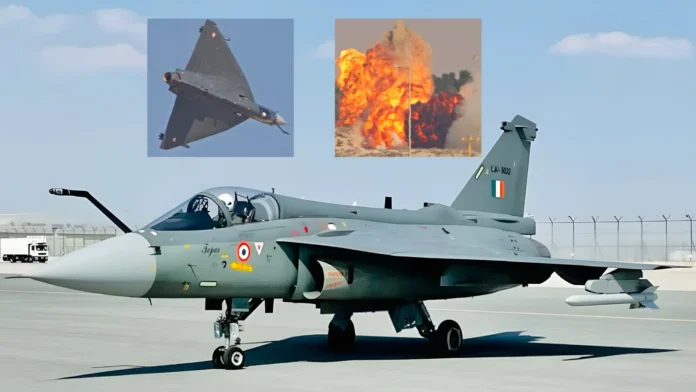
On 21 November 2025, a light combat aircraft (LCA) Tejas of the Indian Air Force (IAF) crashed during a flying display at the Dubai Airshow. The aircraft climbed steeply and then entered a negative‑G turn. Video footage shows the jet suddenly lose altitude and slam into the ground, producing a fireball. The pilot, Wing Commander Namansh Syal, was killed.
The IAF said the crash happened during a scheduled display and ordered a court of inquiry to find the cause. Chief of Defence Staff General Anil Chauhan and the armed forces expressed condolences to the pilot’s family. Dubai’s media office said emergency teams responded quickly to the crash site and managed the situation (Source: livemint.com).
Why the crash matters
Tejas is a single‑engine, delta‑wing fighter built by Hindustan Aeronautics Limited (HAL). It entered service in 2016 and is a central part of India’s plan to modernise its air force and boost defence exports. Until this accident, the aircraft had a strong safety record: the only other Tejas crash happened in March 2024 in Rajasthan, when an oil‑pump failure caused an engine seizure but the pilot ejected safely (Source: gulfnews.com). The Dubai crash occurred during a public display before international buyers, raising questions about demonstration safety and its impact on export prospects.
HAL said the accident appeared to be an isolated incident caused by exceptional circumstances, adding that the company and engine supplier GE Aerospace would assist investigators. The company does not expect the crash to affect its business operations.
What is a negative‑G manoeuvre?
Reports and videos indicate that the pilot was performing a negative‑G turn when control was lost. Negative‑G conditions occur when an aircraft accelerates downward or changes velocity so that forces act opposite to gravity. Pilots and passengers feel weightless or a “floating” sensation during these manoeuvres. Such forces are common in aerobatics, dive recoveries and steep descents, but they reduce the blood flow to the brain and can impair a pilot’s vision and judgement.
Was G‑force blackout a factor?
Defence expert Captain Anil Gaur (Retd.) told the Times of India that from the visuals, it seemed the jet lost control during acrobatics and the pilot may have blacked out due to excessive gravitational force. He explained that “blackout” refers to blood pooling away from the brain, which can happen if a pilot is exposed to large positive or negative G‑forces. Pilots wear special G‑suits to prevent blood from pooling in their legs, but only data from the flight recorder can confirm whether a G‑induced loss of consciousness (G‑LOC) occurred. Articles in other Indian media, including the Economic Times and New Indian Express, also reported experts suggesting that a G‑force blackout might have been involved in the accident (Source: timesofindia.indiatimes.com).
Early technical analyses
Because the inquiry is ongoing, no official cause has been released. However, analysts have outlined several possibilities based on the aircraft design, flight behaviour and video evidence:
- Flight‑envelope exceedance – The Tejas has a delta‑wing design that gives it high agility but limits its ability to regain energy during abrupt changes. Army Recognition noted that aerodynamic stall during a high‑G or negative‑G manoeuvre at low altitude is a key possibility. The crash sequence suggests the aircraft may have lost lift or control authority and there was too little altitude to recover.
- Fly‑by‑wire or sensor malfunction – The Tejas relies on a digital flight‑control system to remain stable. A fault in control‑surface actuation or sensor input could cause an unintended dive. If the system logic is disrupted during an aggressive manoeuvre, the aircraft cannot be flown manually.
- Engine or thrust loss – As a single‑engine jet, the Tejas cannot recover from a power failure below certain speed and altitude thresholds. The non‑fatal Tejas crash in 2024 was linked to an oil‑pump failure. Investigators will examine whether a thrust reduction or fuel‑pump issue contributed (Source: armyrecognition.com).
- Pilot disorientation or g‑LOC – High‑G turns can impair a pilot’s consciousness and spatial perception. If the aircraft entered a downward vector while the pilot was disoriented, there may have been no time to pull up. The absence of an ejection suggests the aircraft’s descent was too rapid or the pilot could not initiate the escape sequence.
- Environmental factors – Dubai’s desert environment has high temperatures, humidity and cross‑winds. Continuous display routines with limited maintenance could lead to overheating or avionics strain. Army Recognition noted that earlier in the week a video showed liquid dripping under a Tejas aircraft; authorities later said it was condensation but any pre‑existing issue adds complexity.
- Bird strike or foreign‑object ingestion – Preliminary visual evidence does not show a bird strike, but it remains plausible due to avian activity near the airfield.
These possibilities are not official findings. Indian Defence Research Wing summarised similar options in an early visual analysis, listing departure from controlled flight due to misjudged pitch angle, fly‑by‑wire failure, engine flame‑out, pilot disorientation, bird strike and environmental conditions.
Experts urge caution
Aviation analyst Saj Ahmad of StrategicAero Research told the Khaleej Times that the manoeuvre appeared to be performed too low, leaving little altitude for recovery. He emphasised that investigations were at an early stage and that many factors—technical, environmental or human—could be involved (Source: khaleejtimes.com).
Army Recognition highlighted that the Tejas is inherently unstable and depends on its flight‑control system. High‑energy displays are risky for any combat aircraft and demand rigorous preparation. The investigation will analyse telemetry data, onboard diagnostics and external footage to determine whether the root cause was mechanical failure, aerodynamic overload or human error. The outcome could affect India’s plans to export the Tejas and may lead to tighter safety protocols for display flights.
What happens next?
The IAF’s court of inquiry will study the flight recorder, cockpit voice recorder, engine performance data and video evidence. Investigators will likely examine:
- Manoeuvre parameters – speed, angle‑of‑attack and G‑forces during the negative‑G turn.
- Engine and fuel systems – to rule out oil‑pump failures similar to the 2024 crash.
- Flight‑control system logs – to detect any software or sensor faults.
- Human factors – including pilot health, workload and training for display routines.
Final findings will be crucial for restoring confidence in the Tejas programme and ensuring safe aerial demonstrations. For now, experts urge patience. The crash underscores how demanding aerobatic displays are and why flight‑safety protocols must constantly evolve.